By Ilias Pelekis
Pelekis Electronics
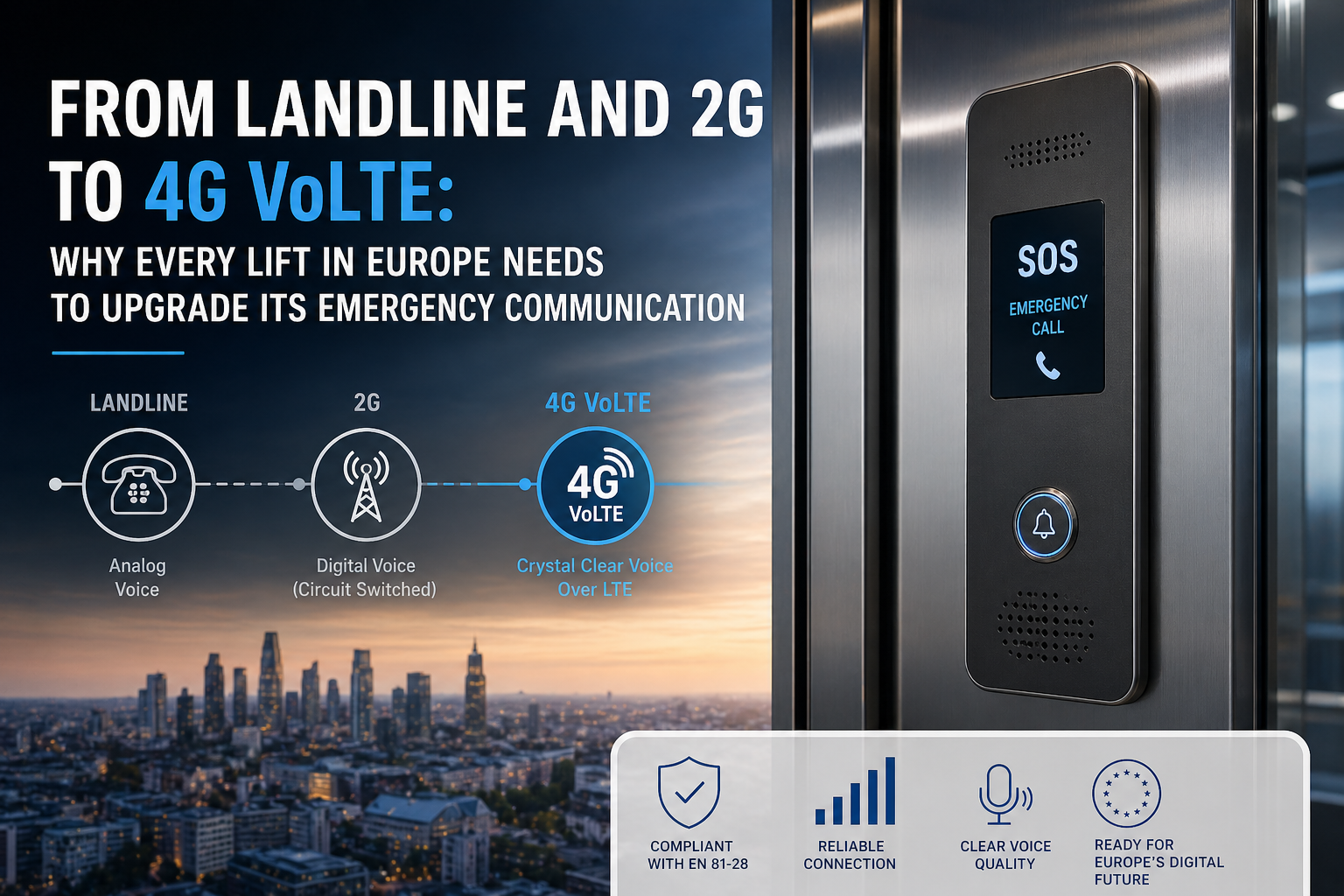
For decades, the alarm button in a lift cabin relied on a fixed-line phone. More recently, it relied on a 2G modem. However, that era is ending fast. Moreover, the schedule is country by country. As a result, most lift owners have not yet caught up.
If your installations still use PSTN copper or 2G/3G GSM gateways, the question has changed. In short, you no longer need to ask, “should we plan an upgrade?” Instead, you should ask, “how soon can we replace the hardware before the network drops the call?”
This post explains what is changing across Europe. First, we cover the network sunsets country by country. Then, we look at why this matters for lift safety and EN 81-28 compliance. Finally, we walk through how a modern 4G VoLTE gateway closes the gap.
The PSTN is gone. 3G is going. 2G is next.
Two parallel network retirements are squeezing legacy lift phones from both sides at once.
The fixed-line (PSTN) phase-out
Across the EU and the UK, telecom operators are retiring copper telephone lines. As a result, all-IP services are taking over. A lift autodialer used to plug into a simple analog wall socket. Today, that socket may not exist at all. Even where the line still works, IP-converted PSTN often brings signaling and DTMF problems. Therefore, traditional autodialers can fail in odd ways.
The 2G and 3G mobile sunsets
Mobile operators are taking spectrum back from legacy networks. In turn, they use that spectrum to grow 4G and 5G capacity. Long before the official switch-off, carriers stop replacing broken 2G cell-site gear. As a result, real-world coverage shrinks year by year. Indoors, the effect hits even harder, since cells were already at capacity. Furthermore, the deadlines are firm, and they differ by country and by carrier.
A snapshot of where things stand in 2026
A short tour of the European map:
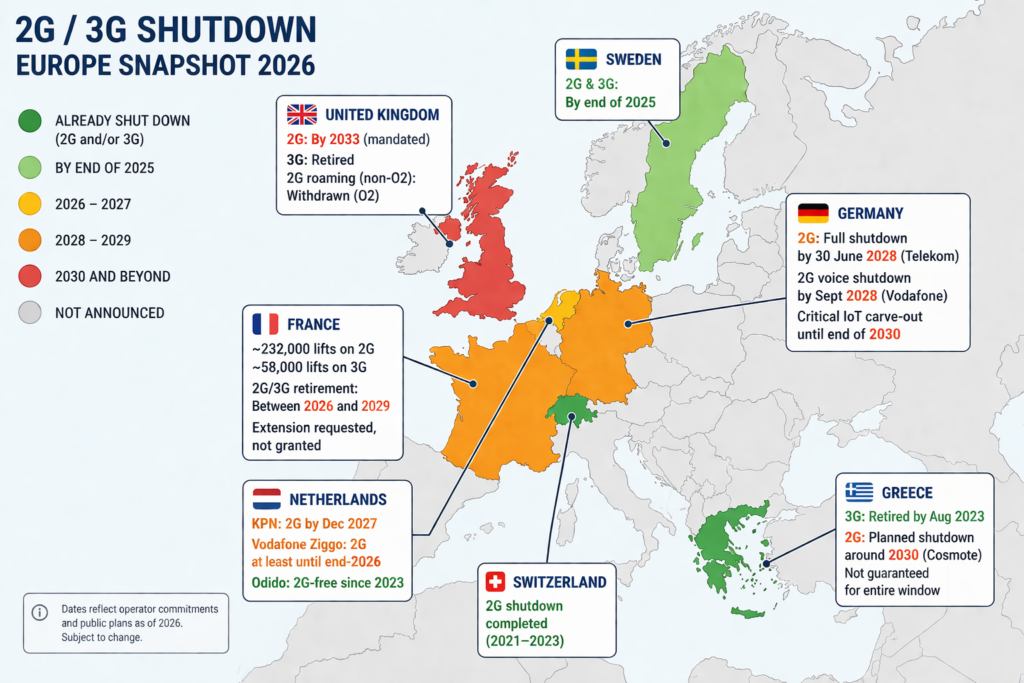
- Greece. All three Greek operators have already retired their 3G networks. Specifically, Cosmote, Vodafone, and Nova (formerly Wind Hellas) wrapped up by August 2023. In addition, every Greek MVNO followed suit, and customers received free SIM swaps. 2G remains for now. However, Cosmote’s 2G is currently scheduled to sunset around 2030. Carriers have not promised to keep it running for the entire window.
- Germany. Deutsche Telekom plans full 2G shutdown by 30 June 2028. Similarly, Vodafone Germany will retire 2G voice in September 2028. After that date, 4G VoLTE and 5G become the only voice paths. Still, a small carve-out for critical IoT applications stays open until the end of 2030.
- France. About half of the French elevator estate still depends on 2G or 3G. In numbers, roughly 232,000 units run on 2G and another 58,000 run on 3G. Operators expect to retire those networks between 2026 and 2029. Meanwhile, the French Elevator Federation has formally asked for an extension. So far, operators have not granted one.
- The Netherlands. KPN pushed its 2G shutdown back from December 2025 to December 2027. As a result, the lift and metering sectors gained two more years to migrate. Likewise, Vodafone Ziggo plans to keep 2G alive at least to end-2026. By contrast, the third operator, Odido, has been 2G-free since 2023.
- Switzerland. Done. In fact, the last Swiss operator finished its 2G shutdown back in 2021–2023.
- Sweden. Operators have committed to a full 2G and 3G phase-out by the end of 2025.
- United Kingdom. O2 has already withdrawn inbound 2G roaming for non-O2 SIMs. In addition, it has retired 3G. Regulators have mandated full 2G retirement by 2033. However, in practice, fallback coverage is shrinking right now.
The pattern is clear. In short, a lift installed five or ten years ago with a PSTN autodialer or a 2G GSM module is on borrowed time. And the time is running out.
Why this is a safety issue, not just a connectivity issue
In the lift world, the emergency phone is not a nice-to-have. Instead, it is a legal must. Specifically, EN 81-28:2022 demands a steady two-way voice link from a trapped passenger to a 24/7 rescue service. If the network goes silent, the lift falls out of compliance. In most countries, the owner must then take the cabin out of service.
What can go wrong on the day the network drops
Here are the concrete risks every installer should know about:
- Failed alarm calls. A 2G-only autodialer in a country with no 2G simply cannot complete a call. As a result, the button still beeps, but no one hears it on the other end.
- Silent degradation. Even before the official shutdown, refarmed spectrum and removed cell sites mean weaker coverage in lift shafts. Notably, lift shafts are already among the worst RF environments in any building.
- VoLTE incompatibility. A 4G modem alone is not enough. To carry voice on an LTE-only network, the device needs Voice over LTE (VoLTE) support. In addition, the carrier must turn on VoLTE for the SIM. Many older “4G” gateways still fall back to 2G for voice. Once 2G goes dark, that fallback fails.
- Roaming gaps. As 2G and 3G fallback disappear, mismatches between handsets, gateways, and 4G/IMS networks can leave users with no voice or SMS path at all — including emergency calls. Therefore, roaming SIMs that used to hop between networks may end up with no working voice channel.
- Vulnerable users hit hardest. Hospitals, residential buildings for the elderly, and accessibility-critical sites depend on alarm reliability the most. At the same time, those are exactly the sites where ageing 2G hardware is most common.
Why industry bodies are sounding the alarm
The European Emergency Number Association (EENA) has urged regulators to publish clear shutdown calendars. Beyond that, EENA has flagged open issues with emergency calls over IMS/VoLTE. Carriers and devices have not yet fixed those issues in the same way across the board. Likewise, the French Elevator Federation has formally asked for deadline extensions. So far, those requests have failed.
The message for installers is clear: do not assume the deadline will move.
What a future-proof lift gateway needs to do
A modern replacement for a PSTN or 2G lift telephone must do more than “speak 4G.” Instead, it has to bridge the old world and the new one cleanly. At minimum, look for these eight features:
- Native 4G VoLTE. Voice flows over LTE end-to-end, not over a legacy fallback. In short, this is the most important spec on the sheet.
- Global band coverage. A gateway sold across Europe needs to handle every carrier’s bands.
- Battery backup that meets EN 81-28. The standard says the emergency phone must keep working during power cuts. Therefore, six hours of run time is a sound baseline.
- Local power supply for the autodialer. A clean 12 VDC output saves an extra PSU in the cabinet. In addition, it keeps the wiring tidy.
- Remote programming and diagnostics. SMS commands, mobile-app config, remote reset, and battery-health alerts cut truck rolls. Put another way, an engineer who can fix things from a phone is not stuck in traffic.
- Pre-recorded voice messages. EN 81-28:2022 expects an auto message to the trapped passenger. It also expects a location and ID message to the rescue centre.
- Honest LED diagnostics. Signal, network, battery, and line status — all visible at a glance, before anyone opens a laptop.
- A SIM-less safety net. If the SIM ever fails — expired, blocked, or missing — the device should still dial 112 on its own.
If a spec sheet glosses over any of these, the device is not really a lift-grade option. In other words, it is just a generic 4G modem in a metal box.
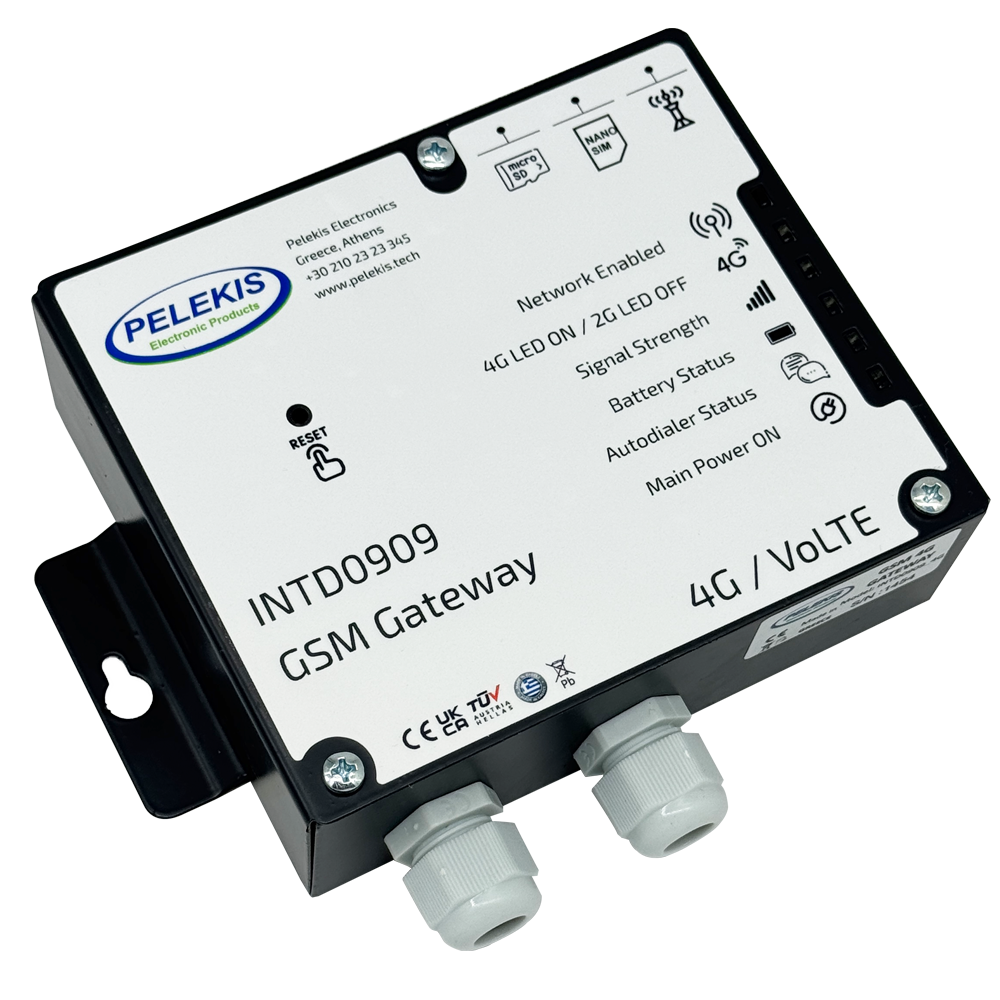
The Pelekis GSM Gateway 4G (INTD0909)
We designed the INTD0909 to replace a tired PSTN line or a soon-to-be-dark 2G modem. Crucially, it slots into your existing emergency-phone chain without forcing a redesign.
Network and coverage
- Native 4G VoLTE with global band support. The gateway falls back to 2G or 3G only where those networks still exist.
- Micro SIM slot. Note that you must turn off the SIM’s PIN code, and the carrier must turn on VoLTE for the line.
- SIM-less mode. In an emergency, the device dials IEN 112 on its own if no SIM is fit to use. In short, this is a true last-resort safety path.
Power and resilience
- 230 VAC mains input with a built-in charger.
- Internal 12 V 0.9 Ah SLA backup battery. In practice, this gives about six hours of standby calls during a mains failure.
- A 12 VDC output that powers the autodialer right from the gateway. As a result, you skip a second PSU in the cabinet.
- Live battery-health checks. In addition, the gateway sends an SMS to a service number when the battery weakens or fails.
Compliance and integration
- We built the gateway to work hand in hand with our RedPhone autodialer (INTD0901 / INTD0902), certified to EN 81-28:2022. Together, they form a full certified emergency-phone chain from the cabin button to the rescue centre.
- Up to two pre-recorded voice messages. One speaks to the trapped passenger (“stay calm, help is on the way”). The other plays for the rescue service (location, building ID, instructions). Best of all, you record both from any connected handset. No PC needed.
- Up to four emergency numbers stored on the device. In sequence, the gateway calls each number until someone answers. After that, it can fall back to 112.
Field serviceability
- Programmable by SMS or by the Pelekis GSM Configurator mobile app on iOS and Android. As a result, you skip the laptop, the cable, and the site visit for routine config changes.
- LEDs on the front cover show network status, signal, 4G/VoLTE, battery, autodialer line, and main power. In practice, you can read the diagnostics in under five seconds.
- Remote firmware update by SD card swap. Therefore, you can handle future network changes by swapping the card alone, not the whole unit.
- 5-year warranty and lifetime tech support from Pelekis Electronics.
Installation tips
Mount the gateway as high as you can in the building. Ideally, set it at the top of the shaft or in the machine room for the best RF. In coastal Greek sites, keep the unit indoors and away from salt-air spray. As a result, the electronics will last for years.
A pragmatic migration plan for installers
If you manage a portfolio of lifts, the cheapest migration is the planned one. By contrast, the most costly one is the emergency callout the day after the local 2G drops.
A workable seven-step plan:
- Inventory. First, for every lift, record the current emergency-phone hardware, the network it uses (PSTN, 2G, 3G, or 4G), and the SIM provider plus contract terms.
- Spot the at-risk units. Anything PSTN-only, 2G-only, 3G-only, or “4G with 2G voice fallback” goes onto the upgrade list. In addition, any SIM that lacks VoLTE goes on the list too.
- Sort by deadline and risk. Above all, hospitals, care homes, single-lift buildings, and sites with weak signal go first. After that, sort the rest by the country-specific 2G sunset date.
- Use one model for the estate. A single gateway, paired with a single autodialer, cuts spares stock, training time, and config mistakes.
- Use VoLTE-enabled SIMs. In particular, ask the carrier in writing to confirm that VoLTE is on. Remember, a 4G data SIM is not always a VoLTE voice SIM.
- Test end to end. Place a real call from the cabin button to the rescue centre. During the test, check both pre-recorded messages on the actual installed unit. Crucially, this is not a bench test.
- Document for compliance. Finally, record the test in the lift logbook. As a result, the next inspector can sign off EN 81-28:2022 right away.
Don’t wait for the network to go quiet
In Greece, the 3G that some older lift gateways still expect is already gone. Meanwhile, in France, a quarter of a million lifts face a 2026–2029 cliff. In Germany and the Netherlands, the dates fall in 2027 and 2028. In short, the window for a calm, planned, batched migration is open right now. However, it will close, country by country, before most carriers post their final shutdown notice.
If you would like a hand auditing your installed base, or picking the right mix of GSM gateway, autodialer, and SIM for your local network, get in touch.
Pelekis Electronics Athens, Greece 📧 info@pelekis.eu 📞 +30 210 23 23 345 🌐 www.pelekis.tech
📄 Product page: Pelekis GSM Gateway 4G / VoLTE 📄 Download the full manual / datasheet (PDF): INTD0909 GSM Gateway 4G — manual 📄 Matching EN 81-28:2022 cabin autodialer: RedPhone Τηλέφωνο Ανελκυστήρα
Pelekis Electronics designs and manufactures emergency communication systems for lifts, certified to EN 81-28 and EN 81-72. The GSM Gateway 4G (INTD0909) and our RedPhone autodialer family are built and supported in the EU, with a 5-year warranty and lifetime technical support.
 Greek
Greek  English